




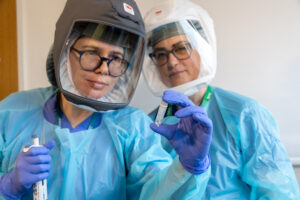












Andrew Catchpole, Chief Scientific Officer at hVIVO
Respiratory viruses don’t wait for clinical trial calendars. Their seasonality, strain variability, and unpredictable circulation patterns have long frustrated vaccine developers and trial designers. But infection can be simulated — safely, reproducibly, and on demand. That is the promise of human challenge models. And as the field evolves, so do the pathogens we need to understand. Respiratory syncytial virus (RSV) was once the frontier. Now, human metapneumovirus (hMPV) is stepping into the spotlight.
hMPV has quietly circulated for decades, but only recently emerged as a global concern. With rising case numbers and no approved vaccine or antiviral, it has become a priority for respiratory researchers. Like RSV, hMPV is difficult to study in the field — often co-circulating with other viruses and evading seasonal surveillance. Earlier this year, outbreaks in China and India triggered pandemic concern from the media, which isn’t possible for this virus as pandemics are from viruses that newly enter the human population from animals. This is the not the case for hMPV but it is nonetheless an important pathogen that causes significant epidemics every winter season.
Human metapneumovirus is elusive, which is why it wasn’t formally identified until 2001 — not because it was new, but because it was so difficult to detect. hMPV was discovered through persistent tissue culture work, where cytopathic effects took up to 17 days to appear — well beyond the standard discard window in most labs. Retrospective serology later revealed antibodies in samples dating back to the 1950s.
Thus, hMPV is not new in the scientific community. It has been known for two decades by the scientific community. However, what is new is the mainstream awareness, and the recognition that it targets the same vulnerable populations as RSV: infants, the elderly, and those with underlying conditions. This history underscores the challenge: hMPV is hard to detect, hard to isolate, and hard to study in the wild. Which is exactly why a controlled, reproducible challenge model is so valuable.
RSV challenge models were a turning point. They demonstrated that symptomatic infection could be recreated in healthy volunteers, enabling early efficacy data and informing later-stage trial design — all within a controlled clinical setting.
The success of RSV was not just about the virus. It was about the infrastructure behind it:
RSV vaccines had failed for decades, sometimes making disease worse. Then the discovery was made on exactly how to design vaccines to produce effective virus neutralising antibodies that solved the problem, the so named preF vaccines, named after the viral protein they target. Vaccine efficacy studies using the RSV challenge models were the first proof of concept that vaccination against RSV could be safe and effective. That data de-risked the field and gave companies confidence to move forward. These elements formed the blueprint for what came next — the development of the hMPV challenge model.
Developing a challenge model for hMPV required more than clinical ambition. It demanded deep lab expertise:
Clinical isolates were sourced from patients who can become infected in the community naturally, some of which were from paediatric patients hospitalised with severe hMPV infection. These samples were triaged for safety, growth potential, and absence of co-infectious agents. The selected isolate was manufactured under GMP conditions with minimal passage, preserving its natural characteristics and minimizing cell adaptation. The final product is a medical-grade virus, frozen in calibrated dilutions and ready for direct human inoculation — no post-GMP manipulation required.
These models are made safe not by weakening the virus, but by careful volunteer selection and rigorous monitoring. That approach allows real infection dynamics to be studied with wildtype viruses while protecting participants.
Volunteers are monitored daily for symptoms, viral load, and patient perception. Symptom severity is scored categorically (0–3), and nasal discharge is measured using pre-weighed tissues — a crude but effective metric. The key endpoint is moderate-to-severe symptomatic infection (grade 2+), which aligns closely with field trial recruitment triggers.
Endpoints must translate. If a volunteer perceives they have a cold and it is bothersome enough to stop daily activities, that is exactly the kind of trigger that determines recruitment in a field trial. Challenge models must mirror that reality, hence careful design of the trial endpoints to ensure that goal is realised.
Unlike previous models, this hMPV study did not pre-exclude volunteers based on antibody levels. Despite this, the model produced high infection rates and robust disease curves. A clear correlation was observed between baseline antibody levels and disease severity — allowing future studies to either stratify or pre-select volunteers depending on the trial’s goals.
This gives two options. If efficiency is the priority, volunteers can be pre-screened to maximize moderate-to-severe infections with fewer participants. If real-world translation is the goal, all comers can be included and stratified. The model works both ways.
The hMPV model was benchmarked against the extensively validated RSV-A model. Disease severity, duration, and symptom profiles were comparable, with hMPV peaking slightly earlier. This similarity reinforces the model’s reliability and its potential to support vaccine development across the pneumovirus family, just as the RSV-A model has already been used so successfully in the development of the current RSV Vaccines
As new pathogens emerge and old ones evolve, the need for agile, lab-enabled challenge models will only grow. RSV showed what is possible. hMPV is showing what comes next.
The future is not about chasing viruses across seasons. It is about designing disease — safely, ethically, and with scientific precision. That is how vaccines and antivirals for the pathogens that matter most will be accelerated.
Learn more about the hMPV challenge model and its clinical data in an upcoming presentation on 3 December 2025. https://hvivo.com/form/on-demand-scientific-presentation-hmpv/
Sign up to our emails and follow us on social media to keep up to date with hVIVO.